Hotel F&B Turnover: Why It Runs So High—and What Helps


Hotel food and beverage (F&B) teams are often among the highest-turnover departments in a property. F&B also carries an operational burden that front desk and housekeeping do not face in quite the same way: it is effectively several small restaurants under one roof. The main outlet, banquets, room service, and the lobby bar may each have different service standards, schedules, and training requirements.
The broader labor market adds pressure. The quit rate across accommodation and food services reached 4.5% in June 2026, compared with 2.2% across the private sector, according to the U.S. Bureau of Labor Statistics. This is a sector-wide figure covering hotels and restaurants together, not a separate hotel F&B rate, but it is the clearest current indicator of how intensely this part of the labor market is moving.
That pressure lands on budgets with less room to absorb it. The U.S. hotel industry paid nearly $128 billion in wages and benefits in 2025 and is projected to approach $131 billion in 2026. At the same time, gross operating profit per available room remains at roughly 90% of 2019 levels as operating expenses stay elevated, according to the American Hotel & Lodging Association's 2026 State of the Industry report.
Key Takeaways
• Accommodation and food services recorded a 4.5% quit rate in June 2026, compared with 2.2% across the private sector.
• Hotel F&B combines multiple outlets, physically demanding shifts, and demand that changes with occupancy and event schedules.
• Fragmented systems increase administrative work and reduce visibility into employee readiness, although available data does not prove they directly cause turnover.
• Standardized mobile training can help managers prepare staff across outlets and track who is ready for which responsibilities.
Why Hotel F&B Turnover Runs So High
Housekeeping and F&B typically carry the highest turnover within hotel operations. Across hourly front-line hotel roles—including housekeeping, F&B, front desk, and bell or valet positions—annual turnover often falls in the 50–80% range, according to Netchex's 2026 hospitality turnover benchmarks. These are Netchex estimates rather than departmental figures published directly by BLS.
For hotel F&B, several operational conditions overlap:
• Multiple outlets create multiple readiness standards. A server trained for the main restaurant is not automatically ready for banquets, and neither role is identical to room service. When each outlet relies mainly on informal shadowing, training quality depends on who happens to be working that shift.
• The work is physically demanding and time-sensitive. Breakfast rushes, banquet turnovers, late-night room service, and event setup leave little room for learning by trial and error.
• Schedules move with occupancy and events. Last-minute changes, fluctuating hours, and event-driven staffing make F&B schedules harder to predict. Netchex identifies schedule unpredictability as a major hospitality retention issue alongside wages and manager quality.
• Managers have limited training time. The same supervisors responsible for service quality, inventory, guest recovery, and staffing are often expected to train every new hire manually.
Training cannot solve pay, workload, scheduling, or management problems on its own. It can, however, remove avoidable confusion from an employee's first weeks and make expectations more consistent across outlets.
What Turnover Can Cost an F&B Department
Netchex cites a widely used estimate that replacing a hospitality worker costs approximately 30–50% of that employee's annual salary after recruiting, onboarding, training time, overtime coverage, reduced productivity, and management time are considered. For a full-time employee earning $16 per hour, that produces an estimated replacement cost of roughly $10,000–$17,000.
Consider an illustrative hotel F&B department with 40 employees and 65% annual turnover. That would mean approximately 26 departures a year. At a conservative $10,000 per departure, the implied annual replacement cost would be about $260,000.
This is not a published hotel benchmark. It is a transparent example showing how the per-departure estimate scales when applied to a department's actual headcount and turnover rate.
Turnover among supervisors and lead roles can create additional disruption. Knowledge of banquet standards, VIP preferences, recurring events, and vendor relationships is not restored simply by filling the vacancy.
How Disconnected Systems Add Friction to F&B Operations
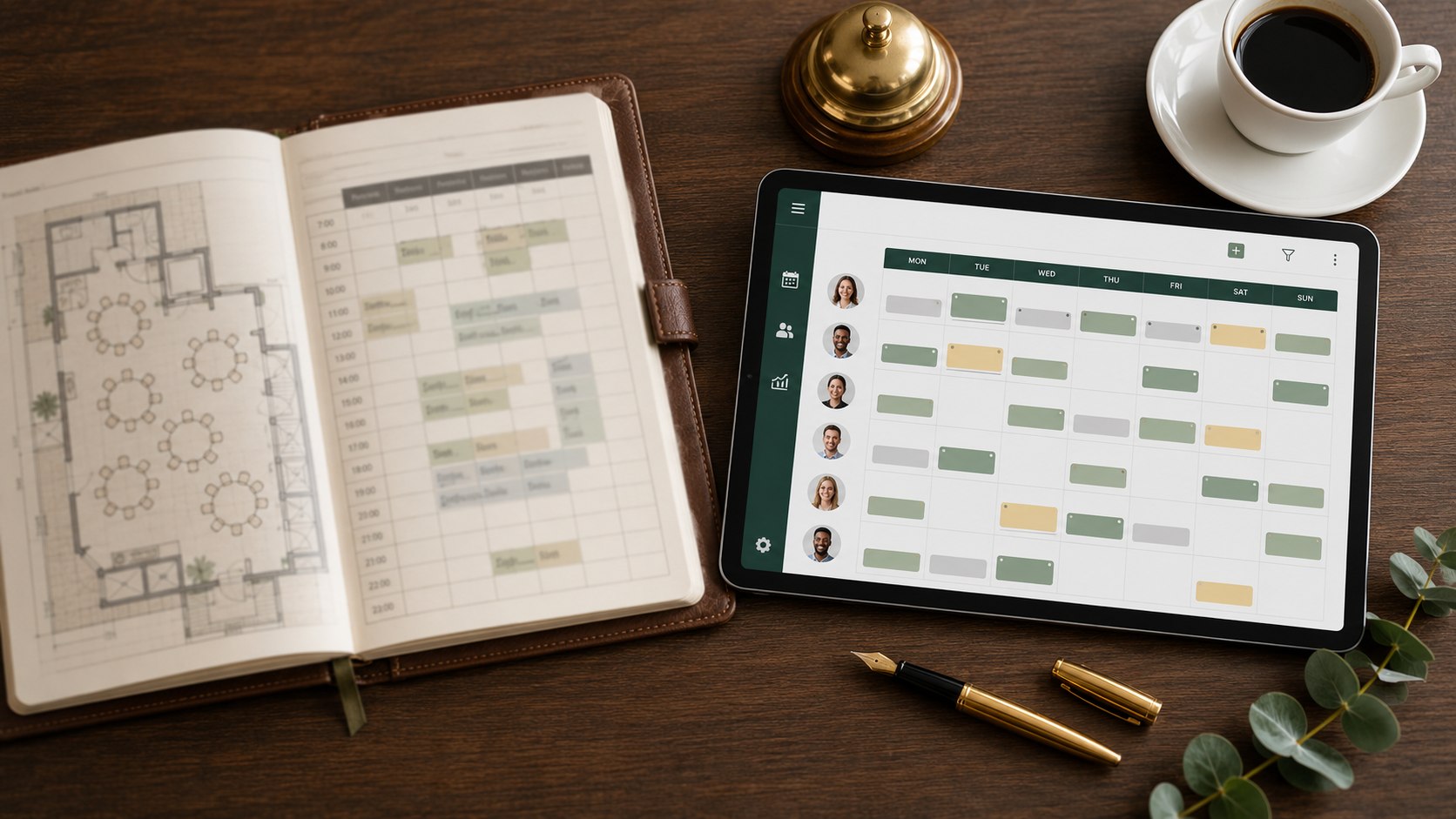
Hotel F&B often spans several tools: a restaurant POS, banquet event orders, scheduling software, group chats, and training documents. When those systems do not share information, managers spend more time reconciling records and employees have more places to search for the correct instruction.
Among independent hotels, 67% identify managing disparate systems as a top operational challenge. Four out of five spend the equivalent of one to two full workdays each week compiling reports and reconciling information across systems, according to Cloudbeds' 2026 State of Independent Hotels report. These findings apply specifically to independent properties; branded and chain hotels may operate with more standardized technology stacks.
For F&B teams, fragmentation can look like this:
• A new hire needs separate logins for scheduling, training, and communication before serving a single table.
• Managers cannot quickly see who has completed training for banquets, room service, or the main outlet.
• Scheduling decisions default to who is available rather than who is demonstrably ready.
• Updates to menus or service standards are published in one place while older instructions remain accessible somewhere else.
• AI tools have limited context because the information they need is split across disconnected systems. Cloudbeds reports that 70% of hoteliers consider integration with existing systems a top priority for AI investment.
The available data documents a substantial operational burden, but it does not establish that fragmented systems directly cause employee turnover. The more defensible conclusion is that disconnected tools can add friction to working and training conditions that are already difficult.
What More Consistent F&B Training Looks Like
One Playbook Across Every Outlet
A digital playbook can document service standards for the main restaurant, banquets, bars, and room service within one structure. Shared core standards can sit alongside outlet-specific procedures, giving employees one reliable place to find current information.
Training Organized Around Real Responsibilities
Content should reflect the outlet, role, and responsibilities an employee is preparing for. A banquet server may need event setup and service-sequence training, while room-service staff need delivery, tray-retrieval, and guest-privacy procedures. This is more useful than assigning every employee the same generic course.
Updates and Knowledge Reinforcement in the Daily Feed
An AI Smart Feed can reinforce outlet-specific updates through manager posts and AI-generated knowledge questions. Employees can revisit menu, policy, promotion, and event information in a familiar mobile format rather than relying on a briefing they heard once several weeks earlier.
Practice That Staff Can Complete in Short Sessions
Gamified lessons turn menu knowledge, ingredients, service steps, and policies into short interactive practice. This makes it easier to reinforce knowledge between shifts without requiring staff to complete a long classroom-style course.
Checklists That Define Readiness
Digital checklists can turn “ready for banquets” or “ready for solo room service” into a specific set of demonstrated steps. Managers can verify completion instead of relying on memory or asking whichever experienced employee is available.
One View of Training Progress
A centralized dashboard can show training, checklist, testing, and certification progress across outlets and locations. That gives F&B leaders a clearer view of who is prepared for which responsibilities before the next large event or schedule change.
Mr. Tomato LXP was built around multi-location, multi-role restaurant operations. Hotel F&B departments face many of the same training and communication challenges, with the additional complexity of several outlets operating within one property. See how the platform supports broader hospitality operations.
What Hotel F&B Leaders Can Control
F&B leaders do not need to replace a PMS or POS to improve training. Those systems serve different operational purposes. The more immediate opportunity is to give employees one consistent place for learning, procedures, updates, and readiness tracking across every outlet.
This will not eliminate turnover by itself. Compensation, scheduling, workload, and manager quality remain central. But clearer onboarding, accessible standards, and measurable readiness are practical levers hotel leaders can control—and they reduce the avoidable operational friction surrounding every new hire.
For a broader look at modernizing training across an entire property, see our guide to hotel staff training and management.
FAQ
Why is hotel F&B turnover often high?
Hotel F&B combines several distinct operations—restaurants, bars, banquets, and room service—with physically demanding work, event-driven staffing, and outlet-specific training requirements. F&B and housekeeping are typically among the highest-turnover hotel departments, although reliable public data does not isolate a single universal F&B rate across all property types.
What is the current hospitality industry quit rate?
The accommodation and food services quit rate was 4.5% in June 2026, compared with 2.2% across the private sector, according to BLS JOLTS data. This figure covers hotels and restaurants together; BLS does not publish a separate hotel F&B quit rate.
How much can F&B turnover cost a hotel?
Netchex estimates that replacing a hospitality employee can cost approximately 30–50% of annual salary. For a full-time employee earning $16 per hour, that is roughly $10,000–$17,000. Actual costs vary by role, market, time to hire, overtime coverage, and training requirements.
Does the systems-fragmentation data apply to hotel chains?
The 67% and four-out-of-five figures cited in this article come from research focused on independent hotels. Branded and chain properties often use more standardized core systems, so those specific figures should not be generalized to every hotel. Multi-outlet training complexity can still exist across property types.
Do disconnected systems directly cause employee turnover?
The available data does not establish direct causation. Disconnected systems can contribute indirectly by increasing setup friction, duplicating work, creating conflicting instructions, and reducing visibility into employee readiness. These conditions can compound other retention problems, but they should not be presented as a measured standalone cause of turnover.
Should hotels train F&B staff separately by outlet or as one team?
A hybrid model is usually more practical: use shared core standards for the whole F&B team, then add outlet-specific modules for the restaurant, banquets, bars, and room service. Cross-training can improve scheduling flexibility and coverage when employees follow consistent standards and managers can verify readiness.
Sources
• U.S. Bureau of Labor Statistics, Job Openings and Labor Turnover — June 2026, released August 4, 2026.
• American Hotel & Lodging Association, 2026 State of the Industry, January 27, 2026.
• Netchex, Hospitality Turnover in 2026: Industry Benchmarks and What They Mean for Your Labor Budget, June 2026. Sector context draws on BLS data; departmental ranges and replacement-cost estimates are Netchex benchmarks rather than figures published directly by BLS.
• Cloudbeds, 2026 State of Independent Hotels: Trends, citing HEDNA's State of Distribution research. The systems-fragmentation findings apply specifically to independent hotels.